
The Best Time to Visit the Paris Catacombs
The temperature underground does not move all year, so the timing question is really about crowds, closing days and how far ahead you have to commit. Month by month, here is what changes.
In this guide
Does the season change anything underground?
Almost nothing. It is 14 °C down there in February and 14 °C in August, and it is humid in both. There is no summer light in a gallery 20 metres below the street and no winter draught either; the one thing weather does underground is nothing at all.
So the whole timing question is a surface question. What changes month to month is how many people want the same slot as you, how far ahead you have to commit, and how pleasant the walk to the entrance is. Pack the same layer whatever the season — a jacket in August feels ridiculous until the first gallery.
Month by month, what actually changes
| Month | How far ahead to book | Above ground | What to plan around |
|---|---|---|---|
| January–February | Days, often less | Cold, short daylight | Nothing much — the quietest weeks of the year |
| March–April | A week or two | Mild, lengthening days | Easter week, which behaves like high season |
| May–June | Two to four weeks | Warm, long evenings | Public holidays and long weekends |
| July–August | A month or more | Hot; the coolest hour of your day is underground | Peak demand, and small-group departures going first |
| September–October | Two to three weeks | Mild, quieter than summer | The best trade-off between weather and crowds |
| November–December | A week or two | Cold, dark by late afternoon | Christmas and New Year weeks, which fill up |
Booking windows describe demand across these departures, not a published release schedule. Official hours and closing days come from the Ville de Paris.
The pattern is simple enough to hold in your head: summer and holiday weeks need commitment, and everything else needs a few days’ notice.
Which day of the week is busiest?
Saturday, then Sunday, then whichever weekday follows a public holiday. Weekend mornings put the largest number of people at the door of a site that only admits 200 at a time, and the pause-and-release cycle at the entrance is at its most obvious then.
Mid-week is materially better. A Tuesday or Wednesday slot in shoulder season is a different visit from the same slot on a Saturday in July, for the same money and the same route.
Friday sits oddly between the two. Mornings behave like a weekday and afternoons like a weekend, so if Friday is the day you have, take an early slot rather than a late one.
What happens on a Monday?
Nothing: the Catacombs are closed on Mondays, all year. It is the single most common wasted journey to this address, and it catches people who have checked the hours for the site but not the closing day.
If Monday is the only day you have, spend it above ground and book the Catacombs for another morning. Montparnasse cemetery is ten minutes from the exit and open, and the history page is the better preparation for a visit later in the week than an afternoon spent at a locked door.
Which dates need checking before you book?
Public holidays. French holidays can shift opening hours, and the site publishes its own variations rather than following a rule you can predict — the Assumption in mid-August is the one most often flagged. Check catacombes.paris.fr for your date before you commit to a non-refundable fare.
Strikes and maintenance are the other two. Both are announced late, and both are the reason a departure that refunds at 24 hours is worth more than the few dollars it costs over one that does not.
How far ahead do slots actually go?
Across these departures, bookings typically run three weeks to two months ahead. That average hides the shape that matters: the small-group departures capped at six and seven go first, because there are only six or seven places to sell, and the self-guided ticket releases the most places and stays available longest.
In practice, if you want a specific date in July, book it when you book the flights. If you want any date in February, a few days is plenty.
The middle case is the awkward one. For a shoulder-season weekend, book two to three weeks out and pick a departure that refunds at 24 hours: that combination costs nothing extra and keeps the date without committing you to it.
Is the first slot of the day quieter?
Yes, and it is the best free upgrade available. The site opens at 09:45; the first entries go in before the day’s queue has built, and the galleries ahead of you are empty rather than full of the group that went down twenty minutes earlier.
The last slots have their own appeal — fewer people again, and a quieter walk out — but they run against the clock. Last admission is 19:30 with closing at 20:30, so a late entry is a visit you cannot linger in.
When is the queue at the entrance longest?
Late morning to early afternoon, at weekends, in summer. The 200-visitor limit means entry is paused when the site is full, so arrivals bunch even when everyone holds a timed slot, and the pause falls hardest on the busiest hours.
A guided departure removes most of this: the operator holds the time and gathers the group away from the ticket window. If you are going direct in August, take an early slot and arrive a few minutes ahead of it.
What changes in a Paris heatwave?
Underground, nothing: 14 °C is 14 °C in a heatwave, which makes this one of the few sights in the city that gets better as the surface gets hotter. It is the coolest hour you will spend on a 35-degree day, and the queue at the door is the only part that suffers.
Two practical consequences. Take water for the wait — you cannot drink underground, but you will want it before and after. And take the layer anyway: stepping from a hot street into cool, humid air is a bigger change than the numbers suggest.
Has anything changed since the 2026 reopening?
A great deal, and it is worth knowing if you visited before. The site closed in November 2025 for a technical renovation and reopened on 8 April 2026 with a new visit route, a new audio guide in four languages, and a lighting system that was completely redesigned rather than patched.
The works were mostly the kind you feel without seeing: new air-handling units, continuous monitoring of temperature, humidity and CO&sub2;, and modernised fire-safety and security systems. One change is visible — the Wall of the September Martyrs was restored using dry-stone walling — and one is audible, since the new commentary is narrated in the voice of Héricart de Thury.
For timing, the practical consequence is that a visit booked now is a better visit than the same visit two years ago, and that the site has just had its long closure rather than being due one. What that does not remove is the ordinary risk of a strike or a maintenance day, which is why the refund window still matters.
School holidays and family dates
French school holidays and the summer weeks are when family demand concentrates, and they are also when the departures suited to families — guided walks on fixed slots — sell out first. Under-14s must be with an adult, so a family booking is never a case of sending teenagers in on their own.
If you are travelling with children in high season, book earlier than you would for yourselves and take a morning slot. The access post covers the stairs and the dark, which matter more to the day than the month does.
Does the time of day change what you see?
Not underground. The lighting is fixed and was completely redesigned for the 2026 reopening, so a 10:00 visit and an 18:00 visit see the same galleries lit the same way. Nothing about the ossuary is better in one hour than another.
Above ground it changes plenty, and that is where to spend the thought. A morning slot leaves you the afternoon in daylight; a late-afternoon slot puts you back on the street at dusk in a quiet residential quarter, which is atmospheric in October and simply dark in December.
What to do when the only slot left is a late one
Take it, and plan the day around it rather than against it. A 17:00 or 18:00 entry is a real visit — the route is fully lit, the galleries are quieter than at midday, and the hour underground is the same hour.
What it needs is a shorter tail: eat beforehand, keep nothing scheduled afterwards, and remember the exit puts you nearly 700 metres from where you started, in the dark for half the year. If the late slot is the only one available on a date that matters, that is a sign to look at the guided departures on Paris Catacombs Tours, which hold their own allocations.
Frequently asked questions
What is the best time of year to visit the Paris Catacombs?
September and October, or January and February if you want it quiet. Underground it is 14 °C all year, so the season only changes the crowds and the booking window.
Are the Paris Catacombs open on Mondays?
No. The site opens Tuesday to Sunday, 09:45–20:30 and is closed Mondays all year, with last admission at 19:30.
How far in advance should I book?
A month or more for July and August, two to four weeks in late spring, and a few days in winter. Small-group departures capped at six or seven go first in any season.
Is it cold in the Paris Catacombs in summer?
It is 14 °C and humid all year, so it feels cool in August and mild in January. Take a layer whatever the forecast says.
What is the quietest time of day?
The first slots after the 09:45 opening, and the last hour before the 19:30 cut-off. Late morning to early afternoon at weekends is the busiest.
Tours that fit this trip
Chosen for what this guide covers, not for what sells.
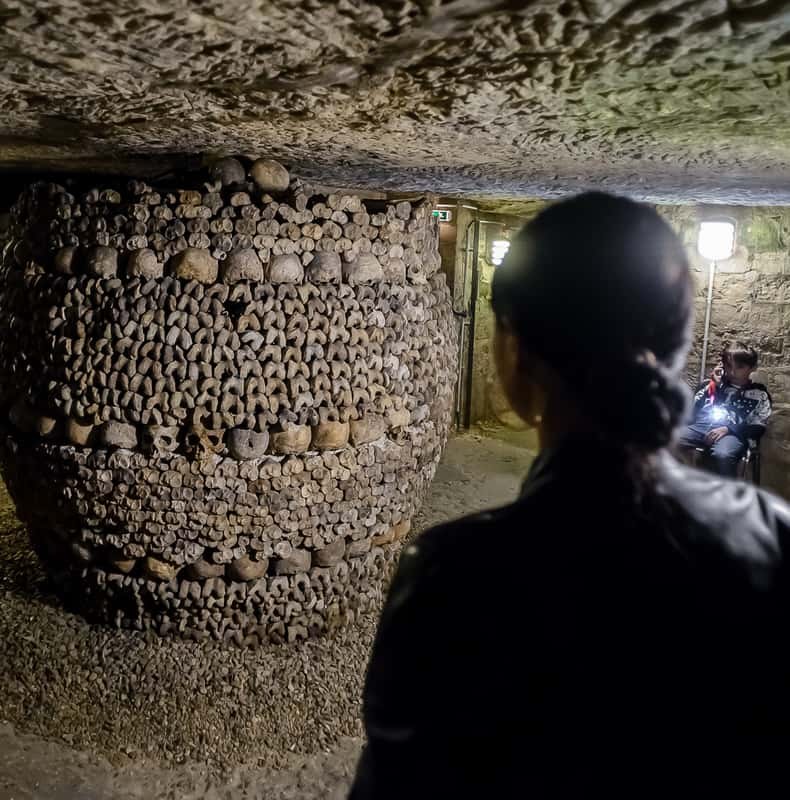
Paris Catacombs Entry Ticket and Audio Guide
Releases the most slots, which is what matters when your dates are fixed.
From $43 per person
Check Availability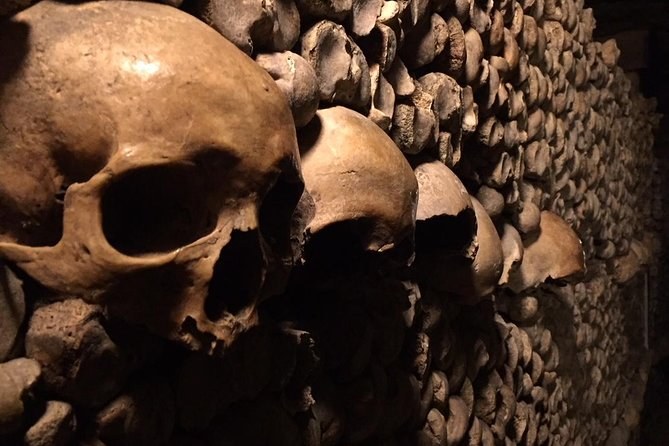
Catacombs of Paris Small Group Restricted Access Tour
Seven places a departure, so it is the first to go in a busy week.
From $223 per person
Check Availability
Paris Catacombs Semi-Private Max 6 People Guided Tour
Six places, booked weeks out in summer — and unhurried when you get one.
From $245 per person
Check Availability