
Paris Catacombs Restricted Access, Explained
Five departures sell access beyond the public circuit, and they do not all open the same doors. This guide sets out what each one names, what the premium costs against the entry ticket, and the days when the gates stay shut.
In this guide
What does “restricted access” actually mean here?
The public circuit is 1.5 km of the 11,000 m² that are maintained for visitors, and it is fixed: the same galleries, the same doorway, the same bone walls for everyone holding a ticket. Restricted access means an operator holds an arrangement to take its group through a gate that stays locked for ticket holders.
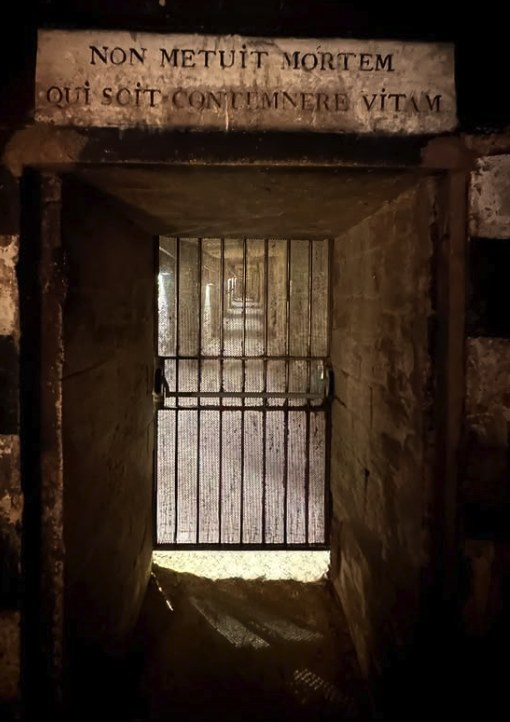
Two departures put a number on it: one names two restricted chambers, another counts its additions as a chapel and a set of carvings. The gates themselves are unremarkable to look at — a barred opening off a gallery you would otherwise walk past — which is part of why the access is worth having explained rather than simply unlocked.
It does not mean the closed quarry network, which is a different thing entirely and is not open to anybody on a paid tour. What is on sale is side chambers within the managed site — lit, maintained, and reached from the same route as everyone else.
Which departures open the gates
| Departure | What it names beyond the public route | Group | Premium over the entry ticket | Free cancellation |
|---|---|---|---|---|
| Paris Catacombs Special Access Tour | The underground chapel, the quarrymen’s carvings, sculpted bone arrangements | 14 max | +$116 | 24 hours |
| Paris Catacombs Tour with Restricted Areas | Two restricted chambers, the Tonneau in the Crypt of the Passion, the lower galleries | 19 max | +$154 | 24 hours |
| Catacombs of Paris Small Group Restricted Access Tour | Hidden rooms closed to the public route | 7 max | +$179 | 24 hours |
| Paris Catacombs Semi-Private Max 6 People Guided Tour | Restricted areas, with six travellers at most | 6 max | +$201 | 24 hours |
| Paris Catacombs Tour with VIP Access to Restricted Areas | Restricted areas closed to general admission | 15 max | +$248 | 2 days |
Premiums are measured against the From $43 self-guided entry ticket with the audio guide. Inclusions are the wording each departure publishes on its own booking listing.
Five of the eight departures sell access of some kind. The other three — the entry ticket, the ticket-and-cruise combination and one guided walk — cover the public route only, and do not claim otherwise.
What is behind the gates?
The additions differ, and the specific wording matters more than the phrase “VIP”. One departure names an underground chapel, the quarrymen’s carvings and sculpted bone arrangements. Another names two restricted chambers, the Tonneau in the Crypt of the Passion, and a stretch of the lower galleries. The rest describe rooms closed to general admission without listing them.
Read those lists as the product description they are. A departure that names three specific places is telling you what you will stand in front of; a departure that says “exclusive access” and stops is telling you less. The galleries and monuments page covers what is on the public route, so you can see exactly where the extra rooms sit against it.
What is the premium worth in real money?
The floor is From $43: timed entry with the audio guide, the whole public circuit, no guide and no gates. Every restricted departure is that visit plus a person plus a key, and the premium runs from about $116 to about $248 per person on top.
Put that in trip terms rather than percentages. For two people the cheapest restricted departure costs roughly what two entry tickets plus a good dinner would; the most expensive costs several times the ticket. Whether that is worth it turns entirely on how much you want to see rooms that most visitors never enter — and for a second visit to the Catacombs, it is the only thing on the market that shows you something new.
Is a smaller group worth more than extra rooms?
Often, yes — and this is the part the fares hide. The two semi-private departures cap at six and seven travellers, and both include access beyond the public route. A capped group in a narrow gallery is a different experience from nineteen people following a raised hand, before anybody unlocks anything.
If your budget stretches to one upgrade rather than two, take the small group. If it stretches to both, the semi-private restricted departures are where the two overlap, and they are the strongest value in the upper half of the range.
What does “skip the lines” actually buy?
It buys a held slot, not a fast lane. Entry is timed for everyone and only 200 people are allowed inside at once, so nobody walks past a queue into an empty gallery. What a guided departure removes is the risk of not getting in: the operator holds the time, and you go to the group rather than to the ticket window.
In July and August, on a Saturday, that is the whole value of the phrase. In February, mid-week, with a slot booked direct, it is worth very little — which is why the timing guide matters to this decision as much as the fare does.
Can the restricted rooms be closed on your date?
Yes. The access is granted by the site, not owned by the operator, so a chamber can be closed for maintenance, for works or for staffing on any given day. It is rare, and it is real: around the 8 April 2026 reopening the public circuit ran while parts of the site were still coming back into service.
Is any of it a private tour?
No. The smallest departure caps at six travellers and the next at seven, which is as close to private as these departures get, and both are shared with whoever else has booked that slot. Nothing here is sold as a tour for your party alone.
What the small caps do buy is conversation: at six people you ask questions and get answers, rather than listening to a guide project down a gallery. For most travellers that is what “private” was standing in for anyway.
Can you photograph the restricted sections?
Photography is permitted in the Catacombs and tripods are not, which applies underground wherever your departure takes you. The light is low, the walls are close and flash rarely gives anyone what they hoped for; a fast lens and a steady hand do better than any accessory you are allowed to bring.
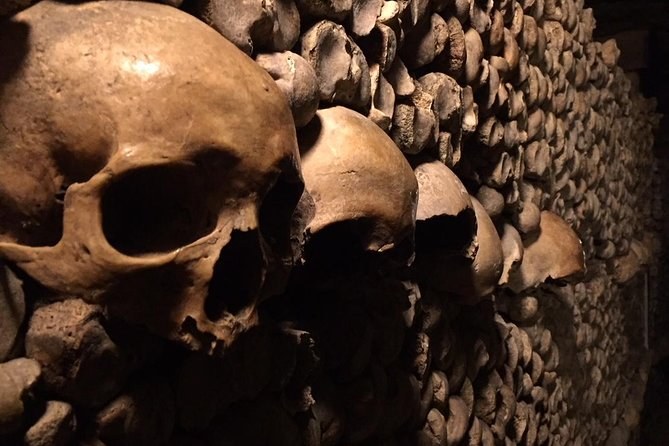
The one rule that is not about equipment: the bones are human remains and touching them is forbidden. That is worth saying plainly on a page about paying extra for access — the access buys you a closer look, not a different set of rules.
Why is the rest of the network off limits?
Because it is neither maintained nor mapped for visitors. The ossuary route is 1.5 km of a quarry system that runs far beyond it, unlit, with no signage, no ventilation guarantee and standing water in places. The visitable area is 11,000 m²; the rest is closed by law.
The story that makes the point is Philibert Aspairt, the Val-de-Grâce doorkeeper who went into the quarries on 3 November 1793 and was found eleven years later. He was buried where he lay, and his tomb is in the closed section, under a street, where no visitor route goes.
What happens if you go in anyway?
Entering the closed quarries is an offence and it is fined. Patrols work the network, the entrances are sealed and reopened faster than they are found, and the people who go down routinely do so knowing all of that.
None of the departures sold here goes anywhere near it, and none of them can. If the off-limits network is the part that fascinates you, the honest answer is that it is a story to read rather than a tour to book — the legends page tells it properly, including who still goes down and why.
Who should not pay the premium?
First-time visitors on a budget. The public circuit is the ossuary: the inscribed doorway, the bone walls, the named monuments, the whole reason the place is famous. Nothing behind a gate changes what you came to see, and the From $43 ticket shows you all of it.
Anyone unsure how they will find it underground should also start with the public route. Ninety minutes is a comfortable first visit; two hours in side chambers is not the place to discover that narrow galleries are not for you. Every departure, with and without access, is compared on Paris Catacombs Tours.
Frequently asked questions
What is a Paris Catacombs tour with secret rooms and privileged access?
It is a guided departure whose operator holds an arrangement with the site to enter chambers closed to ticket holders — an underground chapel, quarrymen’s carvings and sealed galleries. Five of the eight departures sell that access.
How much more does restricted access cost?
Between about $116 and about $248 per person above the From $43 entry ticket. The gap reflects group size as much as access: the smallest departures cap at six and seven travellers.
Are the restricted areas guaranteed?
No. Access is granted by the site and can be withdrawn for maintenance or works, so book a departure that refunds at 24 hours if the rooms are your reason for going.
Is there a Paris Catacombs private tour?
Not a fully private one. Two departures cap at six and seven travellers, which is the closest thing available.
Can I visit the closed quarry network?
No. The 1.5 km ossuary circuit is the only lawful visit; the rest of the network is closed and entering it is an offence.
Tours that fit this trip
Chosen for what this guide covers, not for what sells.
Catacombs of Paris Small Group Restricted Access Tour
Seven travellers maximum and rooms closed to the public route.
From $223 per person
Check Availability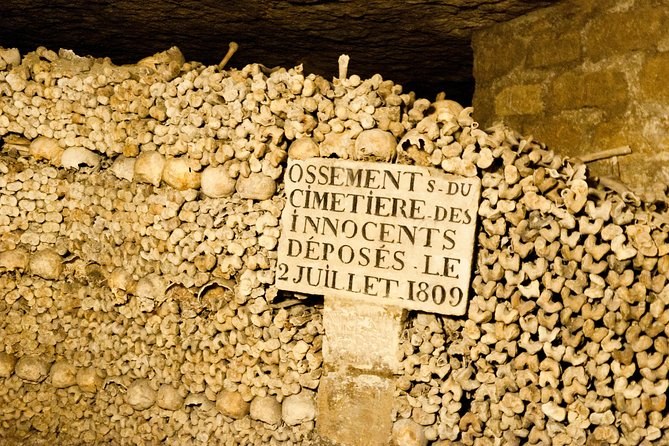
Paris Catacombs Tour with VIP Access to Restricted Areas
The most-reviewed restricted departure, with two days to change your mind.
From $292 per person
Check Availability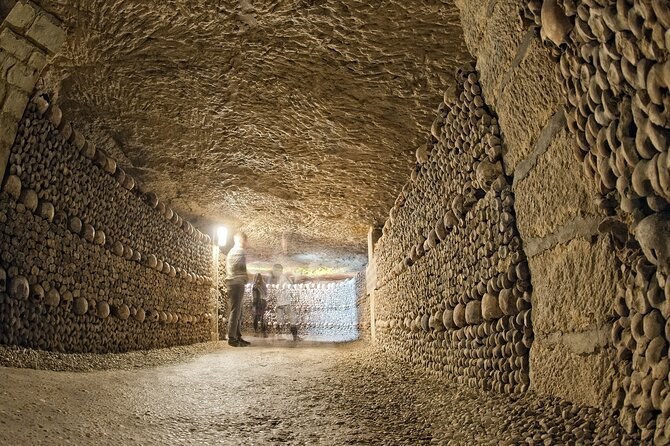
Paris Catacombs Tour with Restricted Areas
Names its additions outright: two restricted chambers and the Tonneau.
From $198 per person
Check Availability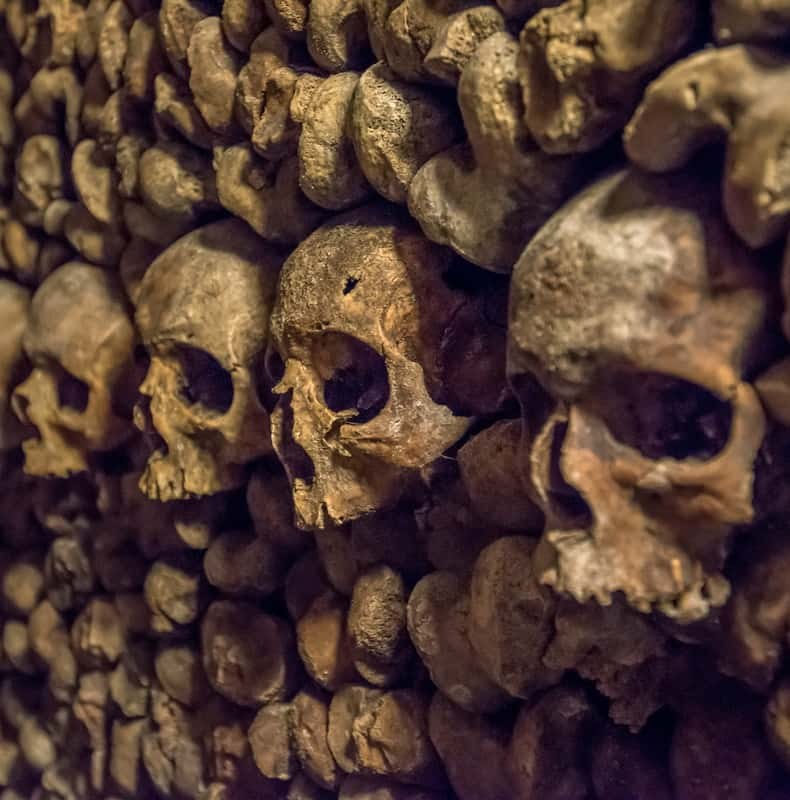
Paris Catacombs Special Access Tour
The underground chapel and the quarrymen’s carvings, at the lowest premium.
From $160 per person
Check Availability