
Inside the Paris Catacombs: the Ossuary Route, Chamber by Chamber
Two halves, and why the first one matters
Almost every account of the Paris Catacombs starts at the bone walls, which skips half the walk. After the 131-step descent you spend roughly twenty minutes in plain worked limestone: square-cut galleries, a low ceiling, floor lighting, and carved street names overhead telling you which road in the 14th you are walking beneath.
That stretch is not filler. It sets the scale of what is under Paris, and it makes the moment the ossuary opens far stronger than it would be if you arrived at the bones straight off the stairs.
The carved street names
Look up. The quarry inspectorate labelled each gallery with the road running above it, dated and lettered, so a surveyor underground always knew where in the city he stood. It is the oldest continuous record of what lies beneath Paris, and it is the clearest illustration of what this place actually is: a negative image of the streets, mapped from below.
Port-Mahon, and the man who carved a fortress
Part-way through the quarry stretch there is a sculpture cut into the rock: a scale model of the fortress of Port-Mahon in Menorca, made by a quarryman in the 1780s. He worked on it in his own time over several years. He died in a collapse while cutting the stairs to reach it.
The doorway: « Arrête ! C’est ici l’empire de la mort »
Two pillars painted in black and white bands, a stone lintel, and the line cut into it: stop, this is the empire of the dead. It is the threshold between quarry and ossuary, and it is where every visit’s photographs begin.
How to read a bone wall
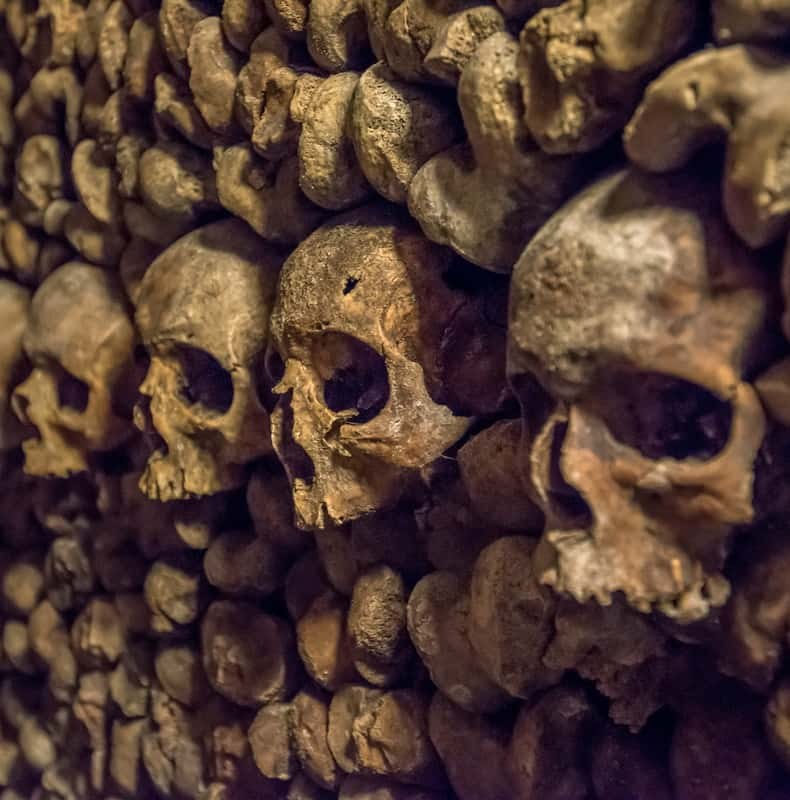
They are not piles. A facing course of femurs and tibias is laid end-on, roughly a metre deep, with skulls set into it in lines, crosses and hearts. Behind that facing, the chamber is filled to the ceiling with everything else — ribs, vertebrae, the small bones — loose.
So the wall you photograph is a retaining face, and the volume behind it is far greater than the surface suggests. Once you know that, the arithmetic of several million people stops being abstract.
The plaques
Set into the walls at intervals are carved stone tablets naming the cemetery a section came from and the month it arrived: Saint-Eustache, May 1787, and so on down the route. They are the transfer record, cut in stone, and they are the point at which most visitors stop treating the ossuary as an installation.
The named monuments on the public route
| Monument | What it is | Why it is there |
|---|---|---|
| The Samaritan Fountain | A well cut by the quarrymen | Water used to wash bones during the transfers |
| The Sepulchral Lamp | A pillar built to hold a flame | Fire drove air circulation so the quarrymen could work |
| Consolidation piers | Masonry columns, dated and lettered | Holding the streets above out of the void |
| Wall of the September Martyrs | A memorial section, rebuilt in 2026 | Remains of those killed in the massacres of 1792 |
| Stone tablets | Carved cemetery names and dates | The record of which parish arrived when |
What a guided departure adds
The public circuit is fixed. Five of the eight departures hold an arrangement with the site to open gates for their group alone, and between them they name four additions:
- The underground chapel — a chamber lined with skulls and femurs.
- The quarryman’s carvings — relief cut into the rock face.
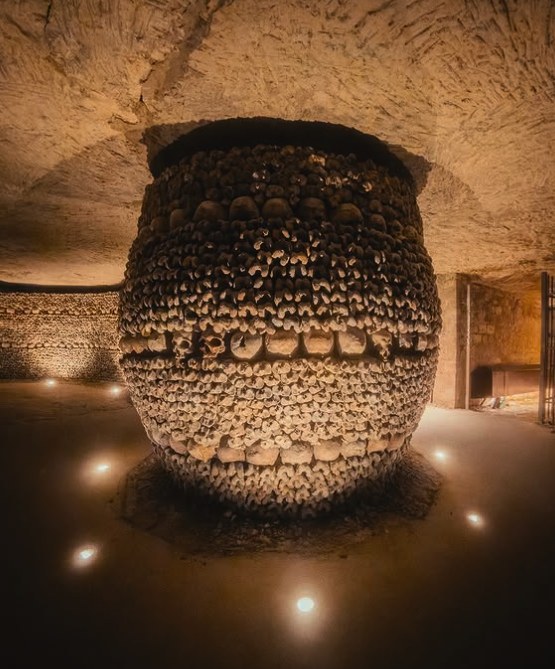
- The Tonneau, in the Crypt of the Passion — a free-standing barrel of stacked bone.
- The lower galleries — a deeper stretch below the main route.
Which of them opens on a given day depends on what the site has cleared, which is worth knowing before you pay a premium for it. The full index is on the galleries and monuments page.
What was rebuilt in 2026
The site closed in November 2025 and reopened on 8 April 2026. The lighting was completely redesigned, the air-handling plant replaced, and continuous temperature, humidity and CO&sub2; monitoring installed to slow the decay of the bone. The Wall of the September Martyrs was rebuilt using dry-stone walling.
The route changed with it and the audio guide was rewritten, now narrated in the voice of Héricart de Thury himself. Older guidebook photographs show a darker, clammier place than the one you will walk.
Where the light comes from now
One detail changes every photograph taken since April 2026: the lighting was completely redesigned during the works. Fittings are set low along the floor and washed up the bone faces rather than pointed at them, which is why the walls read as texture rather than as a display case.
It also means the galleries never go dark and you will not need a torch, but the light is warm and low enough that phone photographs come out grainy. Older guidebook images, lit differently, show a colder place than the one you will walk.
Why the arrangement looks designed, because it is
The instinct on first sight is that the bones were stacked for storage and the patterns are incidental. The opposite is true. When the transfers began the remains were simply tipped into the galleries, and it stayed that way for a quarter of a century.
What you walk through now is a deliberate composition from the 1810s: courses squared off, skulls set in lines and crosses, altars and tablets placed to break the run of wall, inscriptions chosen to be read in sequence. It was built to be visited, by a man who thought a municipal ossuary should also be a monument.
The inscriptions, and what they are doing there
Set at intervals along the ossuary are stone tablets carrying verse and Latin mottoes — among them Non metuit mortem qui scit contemnere vitam, he does not fear death who knows how to scorn life. They are not decoration in the modern sense.
They pace the walk. Each one arrives at a point where the wall would otherwise become monotonous, and each one changes the register of what you are looking at from quantity to individual mortality. That is a piece of exhibition design two hundred years old, and it still works on a room full of phones.
The climb out
112 steps, a bag check at the top — removing a bone is a criminal offence and people try — and a door onto 21 bis avenue René-Coty. You surface nearly 700 metres from where you went in, blinking, in an ordinary residential street. That last transition is, for a lot of people, the part they remember.
For the sensory version of all this rather than the inventory, what it is like inside walks it in order. The questions page covers the practicalities.
Tours that fit this trip
Chosen for what this post covers, not for what sells.
Paris Catacombs Special Access Tour
Adds the underground chapel and the quarrymen’s carvings to this route.
From $160 per person
Check Availability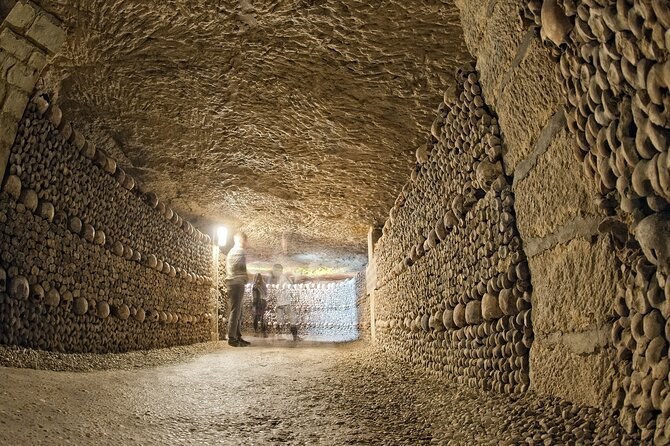
Paris Catacombs Tour with Restricted Areas
Names the Tonneau in the Crypt of the Passion among its stops.
From $198 per person
Check Availability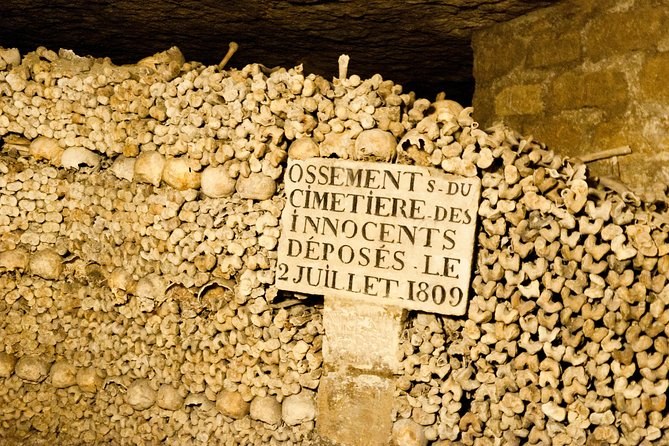
Paris Catacombs Tour with VIP Access to Restricted Areas
Two hours, with time inside chambers the public circuit passes by.
From $292 per person
Check Availability